Z85A Oled Honest Review — Is the Hype Justified?
I've been using the Z85A Oled in my living room for about four months now — the 65-inch model — and I wanted to write a frank, long-form account of what it's like to own and live with this TV. I bought it because the buzz online promised cinema-level contrast, thinness, and top-tier gaming performance. After weeks of movies, sports, multiplayer sessions, and everyday TV watching, here's my honest take: what thrilled me, what disappointed me, and who I think should (and shouldn't) consider this set.
Initial impressions and setup
Unboxing the Z85A felt premium. The set is thin without feeling fragile, and the bezel is minimal — which made the picture feel immersive right away. The included stand is sturdy and modern-looking; I mounted the set on the wall after a week because I prefer the flush look with a low-profile bracket. Setup was straightforward: built-in setup wizard, network connection, signing into my streaming apps, and a quick firmware update that arrived within the first day. The remote is compact and reasonably tactile, though I missed a dedicated quick-access Netflix-style button for my most-used apps.
One practical note from my setup: this TV sits opposite a large window. During bright afternoon hours I noticed reflections on the screen surface. They're not terrible — the anti-reflective coating helps — but if you have a very bright living room with direct sunlight, you should expect some glare. For my typical evenings and daytime with curtains, the picture remains excellent.
Picture quality: the good and the not-so-good
In my experience, the Z85A's headline strength is its contrast. Deep blacks and the kind of local contrast that makes tiny specular highlights pop are what OLEDs are famous for, and this model delivers that. Watching dark scenes in sci-fi and noir films felt cinematic: stars and small light sources had convincing depth, and shadow detail stayed readable without looking washed out.
Color reproduction out of the box was pleasant — lively and saturated without being cartoonish. I did run the TV through a basic calibration profile (film/movie mode, reduced brightness for my room, and a gentle color temperature tweak), and the improvement was noticeable: skin tones looked more natural, and HDR highlights behaved more convincingly. If you value the last 10–15% of accuracy, a professional or app-guided calibration is worth considering.
HDR performance is generally strong. Bright specular highlights look impressive in controlled lighting, and HDR scenes have a good sense of scale. That said, the Z85A doesn't get as blindingly bright as some of the best mini‑LED LCDs on the market. What I found was that in a dim room it performs exceptionally well; in a sunlit living room its HDR pop is reduced compared to very bright LED sets. For my living room, which is more often dim at night, this trade-off was fine.
Motion handling is another positive. Sports and fast-paced action show minimal smearing when I enable the motion smoothing carefully (I keep it low to avoid the “soap opera” effect). Gaming at 120Hz felt fluid and responsive — more on that below.
Uniformity and panel quirks
Most units of OLED I've used have small panel uniformity variations; the Z85A is no exception. In my unit, black-screen uniformity was excellent overall, but under certain very dark scenes I noticed faint near-edge glow in the lower corners. It’s subtle and only visible in extreme test patterns; in normal viewing it didn't bother me. If you're the kind of viewer who watches a lot of late-night movies with static black frames, it's something to be aware of.
Sound, smart platform, and UI
Sound quality from the built-in speakers is competent for dialogue and ambient content. The TV handles speech well and doesn't require a soundbar for everyday streaming. That said, for movies and immersive soundtracks, I quickly added a compact soundbar and subwoofer — the difference in dynamics and bass was huge. The set supports eARC (when connected to my AVR/soundbar the lip-sync and passthrough were reliable), which made the integration painless.
Find top-rated TVs & Home Theater products at great prices.
View Offers →The smart TV software is responsive and snappy. App selection covered everything I use: major streaming services, YouTube, and cloud-based media apps. I appreciated that updates rolled out without drama and that switching inputs, apps, and picture modes didn't feel laggy. The only gripe I had was occasional double-launch behavior on the first day after a major update (an app would launch and then reload); that smoothed out after a follow-up patch.
Gaming experience
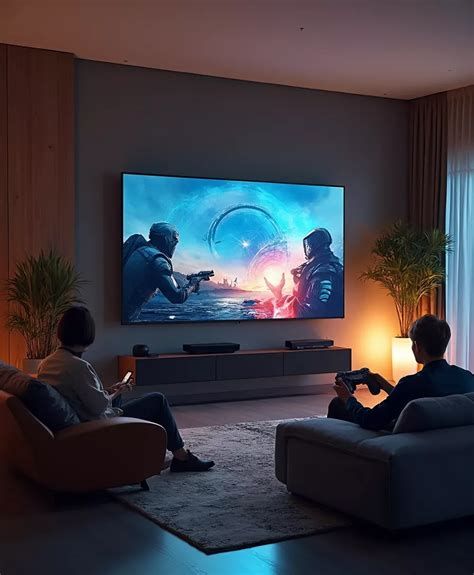
Gaming was one of the main reasons I bought the Z85A, and in my testing it performed admirably. I used both a PS5 and a gaming PC via HDMI. The TV supports 4K at 120Hz, variable refresh rate (VRR), and auto low latency mode (ALLM) — which made the experience very pleasant. Input lag was low in game mode, and fast racing and FPS games felt immediate.
One thing I noticed: in extremely bright HDR scenes in certain games, highlights sometimes seemed clipped or muted compared to how the same game appeared on a bright mini‑LED TV I tested at a friend’s house. For competitive gaming, you won't notice that — but for visually rich single-player titles where HDR highlights are part of the spectacle, OLED’s different brightness profile is worth understanding.
Longevity concerns: burn-in and retention
One of my biggest concerns before buying was burn-in. I use my TV for a mix of TV channels with persistent logos, dashboard-style HUDs in some games, and news tickers. After four months, I haven't experienced permanent burn-in. I did see slight retention after long sessions with static HUD elements (easily visible if I paused the screen on a grid test), but it faded within a few hours after watching varied content. The Z85A includes pixel-shifting and a screensaver to reduce risk, and I've used those features sparingly.
In my opinion, burn-in risk is real for heavy static-content use, but it's manageable. If your usage pattern is static overlays for many hours per day (e.g., a 24/7 information screen), OLED may not be the best choice. If you switch content, use screen-time limits, and enable the panel’s protective features, the risk is much lower.
Pros & Cons
- Pros
- Remarkable contrast and inky blacks that make movies feel cinematic.
- Excellent color reproduction after a simple calibration tweak.
- Excellent gaming features: 4K/120Hz, VRR, low input lag.
- Thin, attractive design that integrates well on a wall mount.
- Responsive smart platform and reliable app support.
- Cons
- Not as bright as some competing mini‑LED sets in very bright rooms.
- Minor panel uniformity quirks at extreme test patterns on my unit.
- Potential burn-in risk with heavy static UI/HUD use (requires mindful habits).
- Built-in audio is fine, but you'll want a soundbar for true cinematic audio.
Quick comparison: Z85A vs. a typical OLED vs. Mini‑LED LED
| Feature | Z85A (my unit) | Typical OLED | Mini‑LED/LCD |
|---|---|---|---|
| Black levels / Contrast | Best-in-class deep blacks; excellent per-pixel contrast | Same — true blacks are an OLED trait | Very good with local dimming, but haloing possible |
| Peak brightness (HDR) | Great for home theaters; less punch in bright rooms | Similar limitation versus very bright LEDs | Brighter highlights; better in sunlit rooms |
| Gaming | 4K/120Hz, VRR, low input lag — great for consoles/PC | OLEDs generally strong for gaming | Also great; sometimes even brighter HDR in games |
| Risk of burn-in | Present but manageable with mixed use | Same | Minimal—LEDs have negligible burn-in risk |
| Price / Value | Competitive for OLED feature set | Varies widely | Often pricier at the high end but very bright |
Buying guide — is the Z85A right for you?
Here are the practical questions I asked myself before buying, and how the Z85A matched my needs. Use these to decide whether it’s a good fit for you.
1) What’s your primary use case?
If you primarily watch movies and TV at night in a dim to moderately lit room, OLED like the Z85A is a fantastic choice: deep blacks, film-like picture, and wide viewing angles. If you use the TV in a very bright living room where daytime watching is common, you might prefer a bright mini‑LED alternative.
2) Do you game on current-gen consoles or a PC?
If gaming at 4K/120Hz and low input lag matter, the Z85A performs wonderfully. I appreciated the smooth responsiveness in multiplayer sessions and the visual fidelity in single-player games. Make sure the model you buy supports the HDMI/VRR features you need.
Looking for the best TVs & Home Theater deals on Amazon?
Browse Now →3) How much static on-screen content will you have?
For heavy, long-term use of static content (channel logos, news tickers, fixed HUDs), consider the burn-in risk. My routine includes varied content so the TV has had no permanent issues after months, but if your usage is very static-heavy, LED/LCD is safer.
4) Do you care about built-in audio?
If you want a single piece furniture solution without extra audio gear, be prepared to accept good-but-not-amazing built-in sound. If you care about cinematic audio, plan a small soundbar — the Z85A integrates nicely via eARC.
5) Calibration and room setup
I recommend switching to the TV’s movie or cinema picture preset, reducing brightness to suit your room, and disabling excess motion smoothing for films. If you want highly accurate color and grayscale, a service calibration or a home colorimeter app will deliver worthwhile gains.
6) Warranty and firmware
One practical thing I checked before purchase was the warranty length and the brand’s track record for firmware updates. I’ve received a couple of firmware updates in my months of ownership, and the vendor has been responsive to minor issues; that mattered to me.
Practical tips from my months of use
- Keep the TV in a picture mode suited to your content: "Movie" for films, "Game" for consoles.
- Enable pixel-shift and the logo-luminance limiter if you watch channels with persistent logos frequently.
- Schedule occasional varied-content evenings (movies, mixed streaming) after long gaming or news-watching sessions to reduce retention.
- Use an external soundbar if you want a true cinematic audio experience — the Z85A’s sound is fine, but I preferred a separate system.
- Place the TV to avoid direct sunlight on the panel during peak hours, or use curtains/blinds; this noticeably improves perceived contrast.
- Keep an eye on firmware updates — they fixed a couple of little UI rough edges early on for me.
Conclusion — do I think the hype is justified?
After several months with the Z85A, I can say the hype around OLED is mostly justified — and this model captures the core advantages of OLED very well. I was consistently impressed by the contrast, the film-like quality of dark scenes, and the gaming responsiveness. What tempered my excitement was the reminder that OLEDs aren't perfect for every scenario: peak brightness in very bright rooms and long-term static content use remain the main trade-offs.
In my experience, if you want cinematic image quality for movies and TV in a typical home theater or living room, and you also value strong gaming performance, the Z85A is an excellent option. If your viewing happens mostly in bright daylight rooms or you need a display that will show static information for long stretches every day, you might prefer a high-end mini‑LED set instead.
Overall, the Z85A delivered a delightful picture and day-to-day reliability. It hasn't been flawless — small uniformity quirks and the constant awareness of burn-in are real considerations — but for the mix of picture quality, design, and modern gaming support it provides, I think the investment made sense for my household. If you prioritize contrast, cinematic darkness, and gaming smoothness, this is a TV worth trying in person and considering seriously.